Part 05 — Credibility
Earn trust before you ask for anything
I broke this part up into two sections. The first is all about external validation including press, public speaking, conferences and awards. You might not be surprised by this point in the framework that I don't place too high a value on these things. They are important to some extent but I don't think they are everything. These are the things you probably think are going to lead to more sales but don't really. I added everything I know and what has worked for me.
The second is what I think is a better strategy which are tactics for building credibility by yourself and double as sales strategy. This covers content & social, email newsletters and online communities. Again we go back to the original anecdote with the band. You're better off to host your own show in your friends backyard than you are to borrow credibility from a name on the sign of a venue. These are the tactics that actually map to your relationship-led sales cycle.
Part 05.01 – Press
How to Get Press without PR
Please don't hire a publicist. Every publicist out there will basically tell you the same thing. That it's impossible to get you press unless you have a celebrity attached to your work. I've worked with many publicists over the years and I mean no disrespect to the industry. It's just that for many startups or smaller creative companies it is not the right approach.
I did work with one publicist once who was fantastic. He got my band a feature in SPIN magazine. But two things to keep in mind that I want to mention. I thought that if you are premiered in SPIN magazine then your life changes, which it absolutely, I can tell you definitively, did not change my life at all. And the second point is that the reason why the publicist worked was because it was a boutique PR firm who was legit obsessed with what we were doing. They were true evangelists. If you can find that kind of relationship then go for it. Otherwise, save your budget.
Ok so, this is how you can get press without hiring a publicist.
Journalists are people. That's it. That's the secret. Journalists are people who are out in the world constantly looking for stories, access and relevancy. They want to cover you. They actually need to cover you! They have deadlines and quotas too. But you need to start to understand the difference between press releases and editorial storytelling.
Storytelling Tips
- Change your framing from "What does my company want to say?" to "What do readers actually care about?"
- Study relevant outlets and see how headlines and hooks pull readers in versus sounding like corporate announcements
- Look at the bylines on articles and notice what are the series sections that they write about with consistency
- Follow the journalists on social media platforms and engage with their content
- Track their contact information as part of your Friend-RM
Each tactic below relates to specific goal you may have around getting press.
#1 — Journalist-as-Moderator
This is a good tactic to use when you want to highlight the people in your community rather than directly yourself
Now that you are a pro at hosting events, invite a journalist to be the Moderator and host your next panel. Work closely with them to develop the topic and subject matter so it is closely aligned and relevant to their beat. Ask if they will live stream the event on social or cover it in some way. Now you have press invested in your work as it is closely linked to their own.
In Practice
We wanted to position the impact B2B brand as a leader with purpose-driven brands, but we had zero budget for PR or paid media. So instead of hiring a publicist, we hosted a panel on brands working on climate change and invited a journalist from a prominent media outlet covering impact to moderate.
Here's what made it work: We worked closely with him to develop the panel topic and choose speakers that would be interesting for his audience. Because he helped shape the content, he was invested in its success. We asked if he'd be willing to live stream the event on their social channels. He said yes.
The result: We got loads of new followers on our channels, tons of great content to repurpose, and coverage from a major climate media outlet — all without paying for it. The journalist got content for his platform, we got distribution and credibility. Everyone won.
What made this work:
- We chose a journalist whose beat aligned perfectly with our event topic
- We involved him in shaping the content (not just "come moderate our thing")
- We made it valuable for HIM — he got content and engaged his audience
- We asked directly: "Would you live stream this on your channels?"
- The live stream brought his audience to us, not just our audience watching
This is the partnership model for press. You're not asking them to cover you. You're creating something valuable together.
#2 — Direct Journalist Relationships
This is a good tactic to use when you want a feature on your founders or business
Journalists are very active on social channels and their contact is usually very easy to find. Identify the outlets that make sense and which journalists could cover what you are working on. This actually shouldn't be that many – maybe 2-3. Follow them on social media and engage with their content. Pitch stories to them directly, by writing a compelling headline that could work for their reporting. Think deliver something ready made but not as a press release, as an editorial article relevant to consumers/readers. They often even post specific guidelines for how to pitch them stories and what they are looking for. [see case study below]
#3 — Original Creative Work & IP
This is a good tactic to use when you want to showcase your capabilities or methodology
In the same way that a Fireside Chat with a client brings to life a project in a way that a case study can not, launching IP can showcase what your company is capable of without telling about your services on your website.
Have a cool idea for a side project you've been kicking around? Build it and launch it! Another tactic a lot of major companies do is work on pro bono or passion projects just for buzz or virality. You can be strategic about finding the right partners and subject matter that journalists want to cover and get people sharing.
Your objective here is to create something genuinely interesting — a tool, a report, a pop up, a video — and let the work do the press outreach for you. The best version of this isn't marketing at all. It's just making something worth talking about.
Here's how to think about it: Sometimes the most successful press has nothing to do with a companies core product. It was a side project that scratched a creative itch, a piece of data they happened to have, or a point of view that nobody else in their space had articulated. One agency I worked at, we developed and produced an original documentary film that we released under our own brand. We premiered it on a major news outlet and it showed what impact storytelling could do for a client.
Playbook
Here's what you do: Think about what you know that nobody else knows. What data do you sit on? What trend are you watching that hasn't been named yet? What would be genuinely useful or interesting to the people you're trying to reach? Build that thing — a report, a creative project, a tool, a visual, a piece of research — and make it good enough to stand alone without your logo or your sales pitch attached to it. Then pitch it to journalists as editorial content, not a company announcement.
Here's what happens: Journalists have something to write about that their readers will actually care about. The story isn't "Company X launches thing" — it's a real story that Company X made possible. That's a fundamentally easier pitch. And because the work is genuinely interesting, people share it without being asked.
Here's what to do after: Put it somewhere permanent on your website, reference it in future pitches as proof of your thinking, and use it in conversations with potential clients and partners. Good IP compounds.
Here's how to measure success: Media pickups, organic shares, inbound conversations that start with "I saw that report you published," and whether it becomes something people reference on their own.
#4 — Partnerships with Media Outlets
This is a good tactic to use when you want to have recurring outlets to bring content, campaigns or stories to
In Practice
When I worked at an agency, we were a small team with zero budget for PR. But we consistently got our work featured and premiered on major outlets like MSNBC, Fast Company, and HuffPost. The trick wasn't a publicist or a press release. It was just that because I had worked in media, I had friends at all these outlets.
When we had a campaign video or project launching, I'd email my contacts directly with a pitch asking if they'd feature or premiere it as editorial content. Because we had a relationship, they'd actually read the email. And because the work was good and aligned with what their audience cared about, they'd often say yes.
This was editorial coverage, not paid placement and that's how we got major outlets to cover our work.
What made this work:
- I had built relationships with these journalists before I needed anything from them
- I only pitched them work that was genuinely relevant to their audience
- I made it easy — gave them everything they needed (video files, press materials, quotes)
- I positioned it as a premiere or exclusive when possible (journalists love being first)
- I wasn't pitching them every week — only when we had something truly worth their attention
Why this might be harder now: The media landscape has completely changed. Many of these outlets have been gutted, journalists have been laid off, and the ones who remain are drowning in pitches.
Personal relationships with journalists will always work better than press releases. You just have to adapt to how media works today — which might mean podcasters, newsletter writers, LinkedIn influencers, or niche Substacks instead of legacy outlets. The tactics evolve but the principle doesn't.
Playbook
Here's what you do: Build your media relationships before you need them — see Press Move 2. When you have something genuinely worth premiering, identify the one journalist, newsletter, or creator whose audience is the best fit. Write a short, personal pitch email. Make the subject line compelling and specific, not generic. Position the opportunity as a premiere or exclusive when you can — people like being first. Give them everything they need: the assets, a short explanation of why it's relevant to their readers, and a clear ask.
Here's what happens: If you've built the relationship right and the work is good, you get coverage without a publicist, without a press release, and without a media budget. More importantly, the coverage feels earned — because it is.
Here's what to do after: Thank them personally and publicly. Share the coverage across your channels. Add it to your website. Use it in future pitches. And keep investing in the relationship — not just when you have something to promote.
Here's how to measure success: Coverage placements, quality of outlets, audience reach, and the ratio of pitches sent to pitches that land. Over time, that ratio should improve as relationships deepen.
#5 — Commission Artists & Creators
This is a good tactic to use when you want to get press on more of holistic or industry wide level or when you want media coverage, organic sharing, and authentic engagement without it feeling like marketing.
Here your objective is to create content so good that outlets want to feature it as editorial, not paid placement. This means working with artists, filmmakers, and creators to tell real stories — not polished brand campaigns.
In Practice
Some of the most successful nonprofit campaigns I've ever worked on looked nothing like traditional nonprofit marketing. Instead of polished fundraising language or branded videos, we let artists, filmmakers, and creators tell real stories — human, emotional, imperfect ones. That kind of work is easier to place in media, more compelling to audiences, and far more effective because it feels authentic rather than strategic.
People connect to stories.

For a climate change campaign, our strategists had a super smart approach: make the campaign "ownerless." Instead of us or the client being front and center, we enlisted a handful of artists to create cross-media work that could stand on its own.
We enlisted well known musicians to write a song for the campaign. We worked with an up-and-coming documentary filmmaker to make a short film about a teen climate activist. We had a celebrity dog participate. We also commissioned an incredible street artist to paint a huge wall mural around our messaging. All of it was better than anything we could have come up with in-house — and because it was real art, not branded content, it was incredibly easy to place and got buzz all on its own.
Media outlets featured the documentary. The song got picked up organically. Photos of the mural went up on social by people passing by. And I was on CNN with the celebrity dog. People shared it because it was great, not because we asked them to.
What made this work:
- We stepped back and let artists lead the creative
- The work could stand alone without branding (it was genuinely good content)
- Media outlets saw it as editorial-worthy, not advertising
- It felt authentic because it WAS authentic — real artists making real work
- The "ownerless" strategy meant it belonged to the culture, not just to us
Playbook
Here's what you do: Instead of creating branded content in-house, commission artists, filmmakers, writers, or creators to make something real. Give them creative freedom. Make the work good enough that it stands alone without your logo plastered all over it. Then pitch it to outlets as editorial content, not sponsored posts.
Here's what happens: Media actually wants to cover it because it's culturally interesting, not just marketing. People share it organically. And you get reach and credibility that paid advertising could never buy.
Here's what to do after: Let it live in the world. Don't over-brand it. Let the work speak for itself and bring people back to your organization naturally.
Here's how to measure success: Media pickups, organic shares, cultural conversation, and how often people engage with it without you asking.
TIP: DOCUMENTATION
Getting press is great but not leveraging it is a waste. "If a tree falls in the forest"... you know the rest.
Here's what to do after getting featured:
- Take screenshots and download images
- Add it to your website
- Add it to your LinkedIn
- Share it on social (once and with gratitude)
- Use it in future pitches: "We were recently featured in [outlet] for our work on [topic]"
The press itself won't change your life overnight but using it as social proof compounds and legitimizes you over time.
[ CASE STUDY ]
The New York Times Feature from a Direct Pitch
Back in 2018, I was living in New York and running a global content studio for a major corporate. I wanted to do something that wasn't work related and I was deep in meticulously decorating my apartment. I became obsessed with interior design and wanted to have my apartment featured on a blog for fun. I pitched it to Apartment Therapy and they rejected me.
Then I started reading The New York Times more carefully and noticed they had a recurring section called "Renters" profiling New Yorkers and their apartments. I looked at the format: they'd tour someone's space, but the story was really about their life, work, and how they lived in the city.
I found the email address for submissions and sent this pitch:
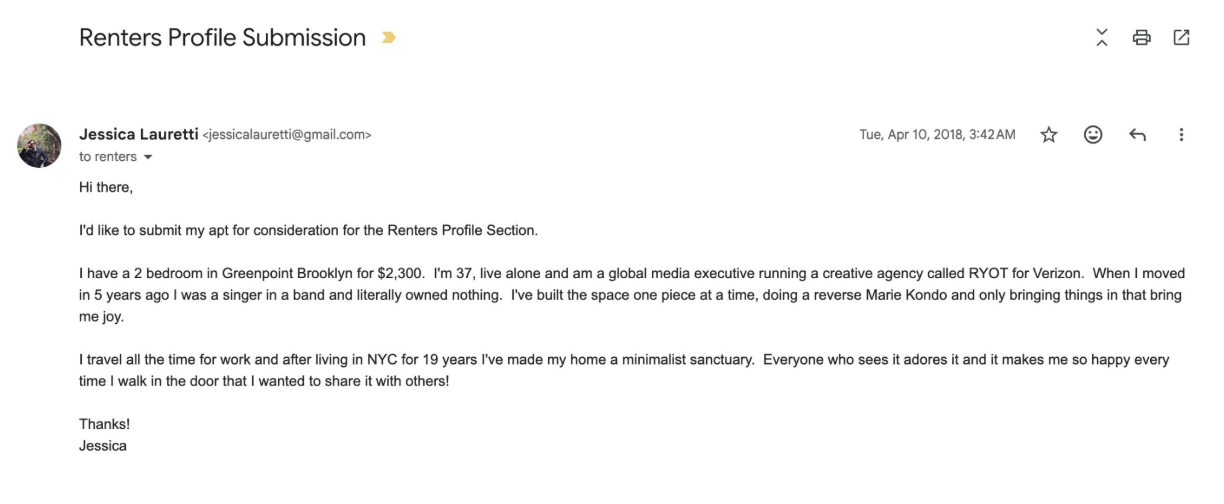
The email was short, personal, and gave them a clear hook: "reverse Marie Kondo." Marie Kondo was everywhere at the time, so I knew they'd get the reference immediately. I also made sure to mention my career trajectory (band to media executive) and why my space mattered to me.
They responded a few months later and set up a shoot. A few weeks after that, I had a half-page feature in The New York Times Sunday print edition. They even used my "Marie Kondo in Reverse" line as the digital headline.
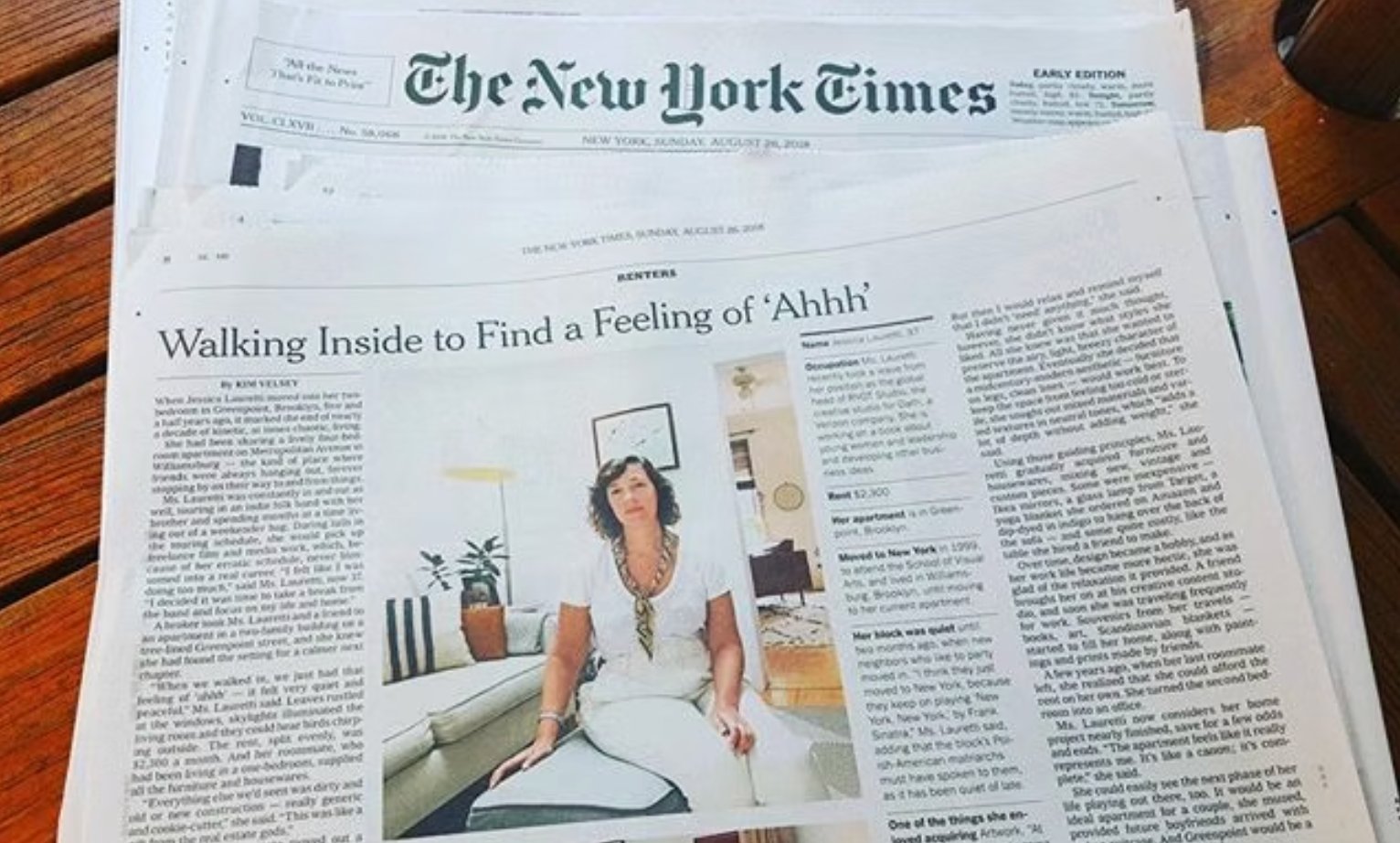
Here's why this was brilliant (even though I didn't plan it this way):
The Renters section let me tell the story of my work and my life through the lens of my space. I got to mention my career journey from musician to executive, my design philosophy, and that I was launching my own company, all wrapped up in a story about how I live. It was actually better than being in the business section, because it was more human and more interesting. People don't remember corporate profiles. They remember personal stories.
What made it work:
- I studied the section and understood the format (they wanted personal stories, not just pretty apartments)
- I pitched with a catchy hook they could use ("reverse Marie Kondo")
- I tied it to something culturally relevant that was already getting coverage
- I kept the email short — 3 paragraphs, under 150 words
- I gave them my full story (band → executive) which made it more interesting
- The Renters section let me talk about my work without it feeling like self-promotion
The feature didn't change my life — but it definitely gave me credibility and became something I could point to on my website and in conversations. The New York Times never goes out of style and people even still mention it to me a decade later. It also taught me that rejection isn't failure. Sometimes you just pitched the wrong outlet. Find a better fit and try again.
Part 05.02 – Public Speaking
Get out there and talk to people
I personally have found more value by hosting my own events rather than speaking on someone else's.
I've spoken on 1 million panels and I'm not sure I really got anything tangible out of them other than company paid travel and having something to promote about myself online. If you do too many, there's also a real risk of becoming known as a professional panelist rather than a builder.
It's also worth noting that many keynote slots are pay-to-play, bundled into brand sponsorship packages rather than earned through expertise alone. This photo below, of me in a headset speaking to thousands, was a paid brand sponsorship slot by the company I was working for at the time.

C2 Montreal Keynote 2018
When you host your own events — even small ones — you control the room, the relationships, and the narrative. You decide who's in the audience. You set the tone. And you're the one who made it happen, not the one who was invited to fill a program.
That said, speaking can absolutely be a powerful visibility tool when you approach it with intention. So if you're going to go this route, here's what I'd recommend.
Playbook
Craft a compelling story and make it personal. People remember real stories. Especially if they are honest, specific, and human. Don't just talk about your company or your metrics — bring the work to life and show why it actually matters to people. When I was doing a lot of public speaking, I crafted a talk that was about my first day on the job. And how I had to jump into VR and learn this new technology literally overnight during a breaking news environment. I talked about how we responded, the questions we had, the things we didn't know and how we solved the problem in real time. This set the stage for everything I said after – the data, tips, actionable next steps – because people felt the gravity of the experience.
Personal and emotional narratives are what make a talk land. They're also what make people come find you afterward.
Learn to talk in soundbites. The best speakers give the audience something to carry out of the room — a line so sharp and memorable that people are tweeting it before you've even left the stage. Think about the one or two sentences that capture the heart of what you believe. Practice saying them out loud until they feel natural. One of my lines from my VR speaking circuit days was "forget everything you know". It was short, sticky and shareable. If someone can't repeat back the core of your talk to a friend at dinner that night, the message didn't land. Give them the words.
Be selective. Quality over quantity of stages. Every stage isn't worth your time. Before you say yes, ask yourself: who is actually in that room, and is this the right audience for what I'm building? One talk to 50 people who are exactly right for your work will do more for you than five panels of 500 people who aren't. Saying no to the wrong opportunities is what keeps you from becoming a professional panelist instead of a practitioner.
A caveat here is that, speaking on a few panels even if misaligned can actually just be good real world practice. If you have a big talk you are gearing up for, book a few in the lead up so you can test your talk with people and make tweaks in real time on whats landed.
And of course you know what I am going to say by now. The through line in all of this is that speaking is only valuable if it builds real relationships and real credibility. Otherwise it's just content.
Part 05.03 – Conferences
The Best Conversations Happen at the After Party
Controversial opinion here but I don't think conferences are really worth attending if you're measuring them against a sales or revenue metric.
I honestly cannot think of a single project or deal I've ever closed that came directly from a conference. Not one. I've been to some great parties though! And I was proposed to once at a villa in Cannes.
I know other people have different stories and swear by doing all their business for the year at CES, Davos or Sundance. But it's just not been my experience.
For me they're crowded, chaotic, and despite being full of people, they can be one of the hardest environments to actually connect with anyone — including people you already know. There's too much noise, too many competing activations, too many side conversations happening all at once. You run into someone you've been meaning to talk to, exchange five minutes on the street, and then you're both pulled in different directions and never pick it up again. (Also why a curated dinner is a good tactic for activating at a conference – see above in events.)
The ROI math rarely works if you're expecting pipeline. Maybe other people have different stories, I can only share from my experience.
That said, I don't think conferences are useless. I think most people just have the wrong expectations going in.
Playbook
Be strategic about which ones you attend. Not all conferences are created equal and your time and budget aren't unlimited. Before you commit, ask yourself: is my actual audience in this room? Are the people I want to build relationships with going to be there? If the answer is no, pass. There are always more conferences.
Schedule high-touch meetings in advance. The best thing about a conference is that it puts a lot of people in the same city at the same time. Use that. Before you go, reach out to the specific people you want to see and book time with them — a coffee, a dinner, a walk between sessions. Don't leave it to chance. The structured side conversations you engineer yourself will be ten times more valuable than anything that happens on the conference floor.
Think of it as top of funnel — not close-the-deal time. Conferences are for planting seeds, not harvesting them. You're expanding your awareness of who's out there, getting a read on where the industry is heading, and making the kind of casual first impressions that can turn into real relationships later. If you go in looking for a deal, you might come home disappointed. If you go in looking to meet interesting people and expand your view, you'll almost always come home with something valuable.
Treat it as a reward, not a strategy. Sometimes a conference is just a good reason to get out of the office, see some familiar faces, hear some new ideas, and remind yourself that there's a whole industry of people out there doing interesting work. That's not nothing. Let it be that. Go, have fun, meet some new people, learn some new things, expense a trip to France — and don't put the pressure of a business development target on an experience that was never really designed for that.
I always say the best thing about a conference is that you have an excuse to email someone the week after. "So sorry I missed you in Cannes this year. Hope you had a fab time!"
The real value of a conference is in the dinner you organized the night before, the coffee you booked two weeks in advance, and the follow-up you send the Monday after. Build around the conference, not just inside it.
Part 05.04 – Awards
How to Win Awards
People love awards. They are shiny, look great on your website and host a super fun party.
That said, they are also a ton of work and can be really expensive to enter. For a small agency or production company, you are competing against big names who have people with full time roles dedicated to working on their entries. Not exactly apples to apples.
I've been on all sides – having run an award platform, having been an awards judge and having been at an agency entering, and my advice is this. Reverse engineer your nomination or win. The award shouldn't be an after thought but the strategy and brief itself. Be really deliberate on which awards and how you can stand out and get noticed. And don't forget that you have to campaign. Make sure you are committed to that cycle before you start.
It doesn't mean you can't win without doing that, but just know that's the standard you are competing against.
Playbook
Only enter work that actually deserves to win. This sounds obvious but it's not how most people approach it. There's a temptation to enter everything and see what sticks — but that gets expensive fast, and it dilutes the energy you bring to your strongest entries. Be ruthless. Pick the work you're genuinely most proud of, the project that really shows what you're capable of, and put everything into that submission. A well-crafted entry for one award will beat a rushed entry for five every time.
Spend time on meaningfully crafting your entry. An entry is a story you are telling about the project. Why you made it, how you came up with the idea, how impactful it was. You need to really think of this as sales marketing and not just answers to fields in a form. Some of your competitors entries are going to be making highly produced case study videos or other designed assets. You don't have to do that to be considered but try to think from the perspective of the judges who know nothing about it, and how can you tell the story of the project in a way that makes them really get it.
Be strategic about what you do with a win. An award is only as valuable as what you do with it after. The announcement, the press, the team celebration, the case study you update, the way you work it into your pitch deck and your website — that's where the real return is. If you win something meaningful and add a logo to your footer, you've left most of the value on the table. Plan the follow-through before you even enter.
Awards can be a genuine signal of quality and a real boost for your team's morale and your company's credibility. Just make sure the ones you're chasing are actually worth winning — and that you have the bandwidth to do them justice.