Work Friends
The day after my 30th birthday, I was hungover and broke. I was having coffee with a friend and said to them, "I need a job, any job. I will do anything, help!" He was working at a digital media company who was hiring for a new music vertical they were launching. He got me an interview there the next week. I started working as a freelance video editor the next day. I thought it was going to be a two and a half week project and it turned into a full-time job for two and a half years.
When I reflect back now on my 20 year long career, all of the jobs that I ever had, they all happened exactly like this. They all came through my network of friends and colleagues and they all started as a freelance, short-term, entry-level contract that then evolved into longer-term and more senior full-time roles. This was true when I was a production freelancer, had senior leadership and executive roles and the same is true now that I am running my own company.
While working at that digital media company, I worked with dozens of people. One of them later started her own company and hired me. She also referred me to another job. Another one was married to someone who hired me years later at a different company. A third one was the reason I got a job in Madrid years after that.
A fourth one recommended me for a dream job. I didn't end up getting it but that hiring manager remembered me and hired me as a consultant years later. And that original friend who recommended me? I hired his company at my next role.
One job in 2010. A dozen relationships. Those relationships turned into four more jobs over the next decade — across different companies, different cities, different continents. The friends that I made and the relationships I built were the single biggest growth multiplier of my career.
But the story doesn't end there.
After I left that digital media company, I was walking home on my last day and texted 5 friends. I told them all that I was freelance again and looking for new projects if they heard of anything that would be a good fit. One friend texted me back immediately and said, "Do you want to produce a video shoot? You would start tomorrow." I said, yes without even knowing any of the details and started the next day.
After producing that first shoot, the agency hired me again for a second shoot and then again for a third. Then they offered me a full time director role working between partnerships and the creative team that we built out the job description together.
A year or so later, I hired a production company for a campaign we were working on and became friends with the Executive Producer there. He then introduced me to the founder of a startup he thought I should connect with. We met and instantly clicked. Soon after, that startup was acquired by a larger corporation and the founder called me to help him out.
He was working in Virtual Reality news and he said to me, "You will have to become a virtual reality expert overnight and you will be flying around the world talking about the future of storytelling. Are you in?"
I started on a 3-month contract in the news division and 6 months later I became the Global Head of the Studio at a major corporation with 16 teams across the world and responsible for hundreds of millions in revenue.
Once I was in a position to hire, I reached out to all the people I had worked with before at multiple previous jobs. I hired a team of 30 people all through my network and through word of mouth in 9 months.
See where I am going with this?
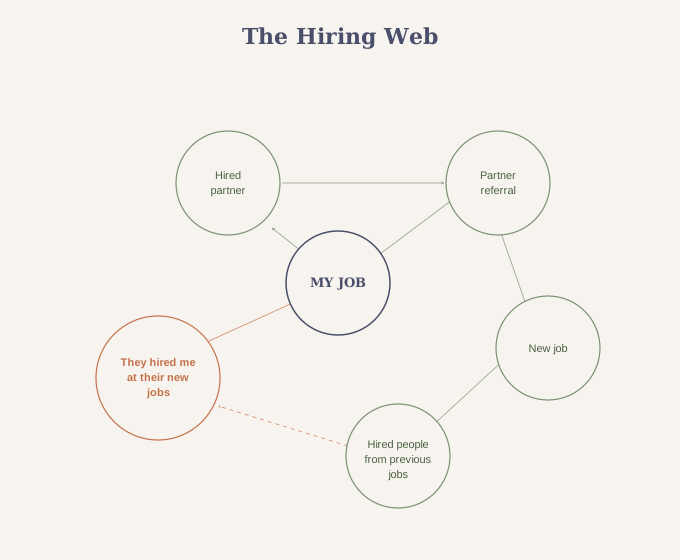
But wait, there's more!
A woman I worked with at that major corporation became my first client when I officially launched my consulting practice. I did one project with the new company she was working at. That led to a second project with their parent company. Then I worked with one of the other startups under that umbrella. Then it led to actually 2 different full time roles I was considered for (neither of them ended up working out). Then I brought one of those startup founders I worked with onto a brand I was launching.
One colleague from corporate. Five years later, she's not just a client — she's a gateway to an entire portfolio of companies and back into my other work.
And another:
My next leadership role came about because of people I knew from three jobs prior. One friend recommended me to the hiring manager, and while I did have to apply and go through a process, and I was absolutely qualified, I had an in.
While there, I became friends with someone who had worked at the same media company as me years ago, but in a different office so we had never met. We both left that particular role but then a short time later, she called me about another project she was working on and we worked together again for another year. (This is the role I talked about in the Introduction, the one where I started freelance and then became C-Suite.)
And one last one:
The last client I had was a person I had worked with for 2 weeks over 4 years ago. She saw a LinkedIn post I had shared that I was looking for new projects and reached out to collaborate.
Every job led to the next job. Every person I worked with became part of a network that kept compounding. I didn't plan it this way. I just did good work, treated people well, and stayed in touch.
Nearly fifteen years later, I'm still working with people from that original media job. They've moved companies or even industries five times. So have I. But the relationships stayed.
This pattern is too consistent to dismiss.
Your opportunities don't come from luck. They come from your relationships.
Your relationships don't disappear when you leave a job. They follow you through your entire career. The person you hire today might hire you five years from now. The colleague you support might introduce you to your next opportunity. Your brother might have a friend from college who needs exactly what you do.
You can't predict which relationships will compound or when. That's why you invest in all of them. That's why you stay in touch. That's why you show up for people even when there's no immediate benefit.
Once I saw how deeply important relationships were to my own career development and business growth, I wanted to develop a way to codify it, so that anyone could do it with intention.
Secret to Sales
Before we go on to the framework, I want to track how sales and business works against this pattern, to show you why relationships are so essential to growth and opportunity.
Most people think business works like this:
Resume/Proposal + Client = $$$
I wish. If only it were that simple. It seems obvious to say, but you don't go from being total strangers with someone to them paying you a million dollars overnight.
In reality, the equation for business success really looks more like this:
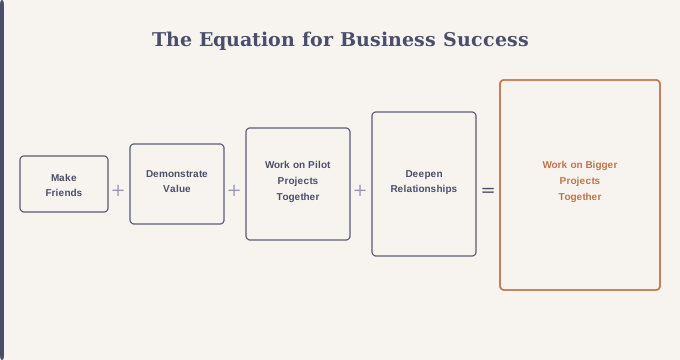
This is the same whether you're looking for a full-time role or doing business development for your agency. You need to know the person hiring, work on a pilot project together, then build your way up. This core principle has been true on a $6k/$50k/$250k project for my solo business as well as when I was running sales at a $12m agency and at a $160m global content studio. If we didn't have a relationship with the client, we didn't get the job.
That's the cycle that I had been running all of these years without even being aware of it. Turns out the secret to my success was just running a job search the same way you would run a sales cycle.
Right now you are trying to skip from making friends to working on bigger projects together. That's why you are stuck. You can't jump ahead, you have to go through all of the steps in between to get there.
The other thing you are doing is neglecting the people you already know and have worked on pilot projects with. You are spending a lot of time and energy on trying to meet new people when you are forgetting about the people right in front of you.
You know that saying, "It takes 20 years of hard work to become an overnight success."? That's this cycle in action.
Sales is Relationships
The core of this framework is that you are probably over thinking and over complicating what you think of as sales. You might think of it as having to be someone you're not or as requiring a ton of work that you don't have time for.
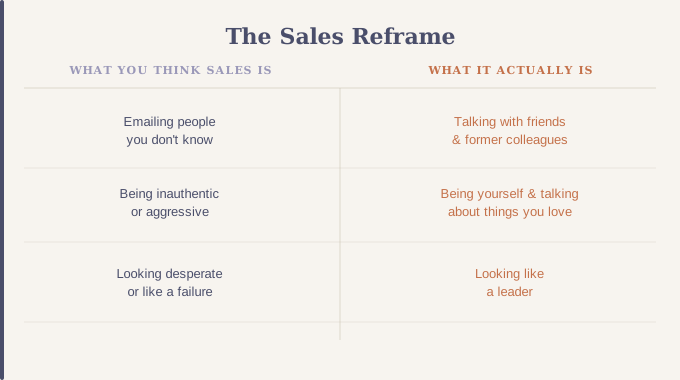
You don't need to do either of those things to be successful. All you need to do is, find an ongoing way that helps you connect with the people you already know and the new people you want to meet. Find a way to offer value to friends and partners. And find a way to work on pilot projects together.
To say this as simply as I possibly can: the more you do stuff you love, the more you meet people who also love the same stuff and then the more you can do the stuff you love together.
It shouldn't really feel like work. It should feel like calling your friends.
Make art! Write a blog! Throw a party! That's it. That's the secret to business.
It's Not Networking
You have organization and structure around every other part of your life and work. You have systems for managing your finances, your calendar, your projects, your workflows.
But when it comes to who you know and who you want to meet? It's like we go blank. We don't want to do cold outreach because that feels icky, but we also don't want to reach out to people we know because that feels vulnerable. We feel more comfortable with an anonymous process (like an application or an RFP) even if we know deep down that it's not effective.
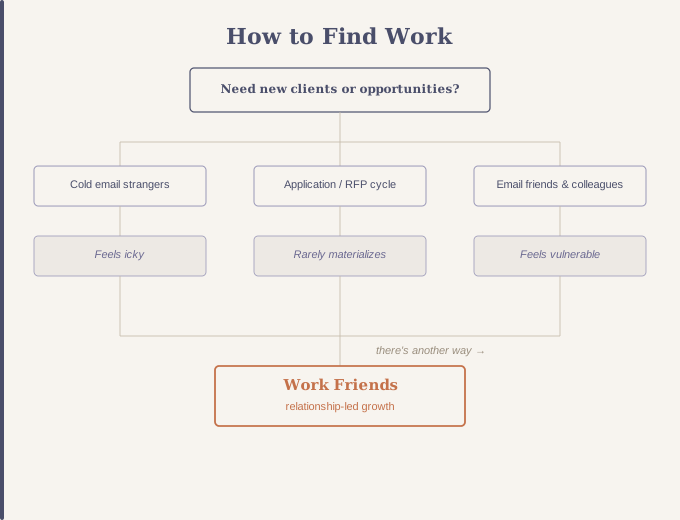
We say we hate self-promotion, or that we are bad at sales and business development. Really we're just scared — scared of reaching out, scared of being rejected or ignored. So instead of building intentionally, we do nothing and leave it to chance.
Well, I am on a personal mission to make you see how fun and easy it really is.
People hate networking because they go to a meetup once, meet a bunch of people they don't really have anything in common with who they never talk to again and nothing ever comes out of it.
Relationship infrastructure is the system you build for intentionally meeting new people and consistently staying in touch with the people you already know. It works for finding jobs, gigs, clients, partners, co-founders and press. It's treating relationships like the business asset they are.
Impact Statement
Relationship-led growth only works if your relationships aren't limited to people who look like you, think like you, or come from the same rooms you already occupy.
Most professional networks are shaped by proximity, privilege, geography, education, and access — not merit or talent. Left unchecked, "relationship infrastructure" can reproduce the same narrow circles over and over again. Work Friends is designed to do the opposite. It's a system for intentionally expanding who you know, who you listen to, who you collaborate with, and who gets access to opportunity through you.
In a moment when formal DEI programs are being rolled back and institutions are retreating from equity commitments, individual behavior matters more than ever. Building broader, more diverse, more inclusive relationships isn't political — it's practical. It makes your work better, your thinking sharper, your teams stronger, and your businesses more resilient.
This framework is about getting out of your bubble. It's about designing rooms where new voices enter, new perspectives shape decisions, and opportunity circulates more fairly. The work is simple, human, and powerful: make new friends. Invite different people into the room. Build growth by expanding who belongs.